Pages

Sunday, October 28, 2018

Boy have we been busy bees!

Hello!  We have made changes to the schedule and just wanted everyone to be on the same page.  Here is the new schedule:

8:00 - 8:40 - Science/Social Studies
8:40 - 9:00 - Morning Meeting
9:00 - 9:20 - Snack and Read Aloud
9:20 - 9:40 - Recess
9:40 - 10:40 - Reading Workshop
10:40 - 11:25 - Word Study and Writing Workshop
11:25 - 12:25 - Specials
12:25 - 12:35 - Handwriting practice
12:36 - 1:01 - Lunch
1:01 - 2:10 - Math
2:10 - Pack up, Roses, and Dismissal

View image on Twitter


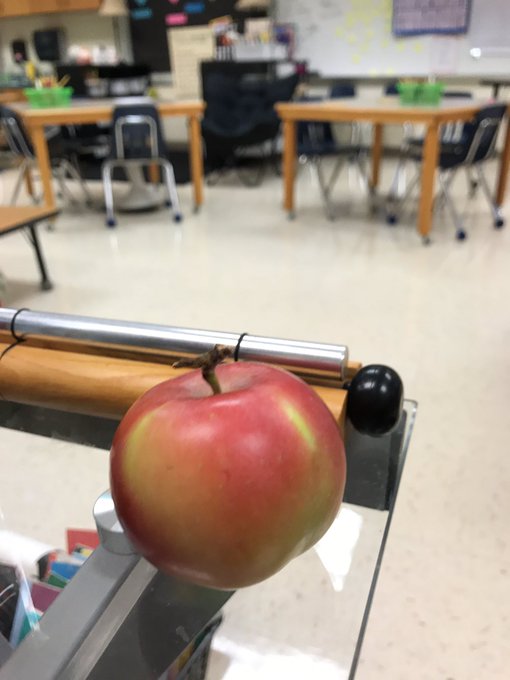
I have been reading a historical fiction book where the teacher in the book received an apple.  I have gotten several in the last two week from sweet children!  :)
View image on Twitter

Now, what's been going on in 2nd grade...

Science/Social Studies:
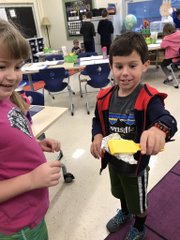
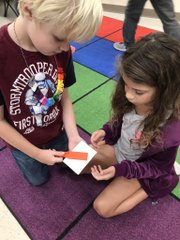
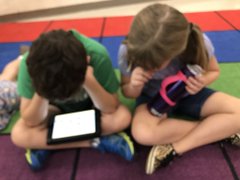
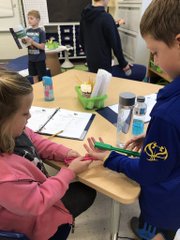
We have just transitioned into Science with our first unit...magnets!  Students have explored the types of material that have a magnetic field that attract magnets and which materials repel magnets.  Student have been testing the magnetic force of the poles.  All of these fancy words are vocabulary words your child should know, so don't be afraid to use them at home!
 View image on Twitter  View image on Twitter  View image on Twitter  View image on Twitter

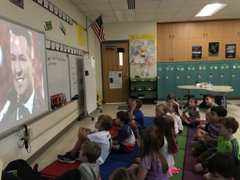
We have also learned about two famous Americans; George Washington Carver and Helen Keller.  Students learned that George Washington Carver came from a slave family, but went to school to become a famous botanist who realized that rotating crops (specifically cotton and peanuts) was beneficial to the soil and kept plants healthy.  He found many uses for peanuts (oil, cheese, dye, etc). 

When reviewing all that we now know about George Washington Carver, students shouted out things they remembered and I wrote them down.  We then started a sequencing lesson by placing them in chronological order.

View image on Twitter

Students have also felt braille and will make their own braille words in word study in the upcoming week because we have learned about Helen Keller.  She was born with the ability to see and hear, but due to a severe fever, she lost her sight and hearing as a young child.  After several frustrating years, her parents hired a teacher, Annie Sullivan, to help her become part of our world again.


Ways to help at home:
- Pull out some magnets and let them go to town!  They can wander around the house trying to figure out what attracts magnets.  Remind them to stay away from your phone or computer!  ;-)
- Students can also get onto Pebble Go (BES homepage, Library, Research & Learn, Pebble Go at the bottom) to read, listen, and explore more about George Washington Carver and Helen Keller.

Word Study:
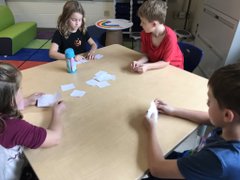
I work with each group for about 20 minutes so they know the reason behind their sort.  Students then write their sort one time and do some type of activity.  Students can log in to Spelling City from home to practice through fun games.  Simply do a Google search for Spelling City, click login at the top right, then click student login, then they enter their username and password (exactly like they login to their computer at school).

View image on Twitter  View image on Twitter  View image on Twitter  View image on Twitter

Writing:
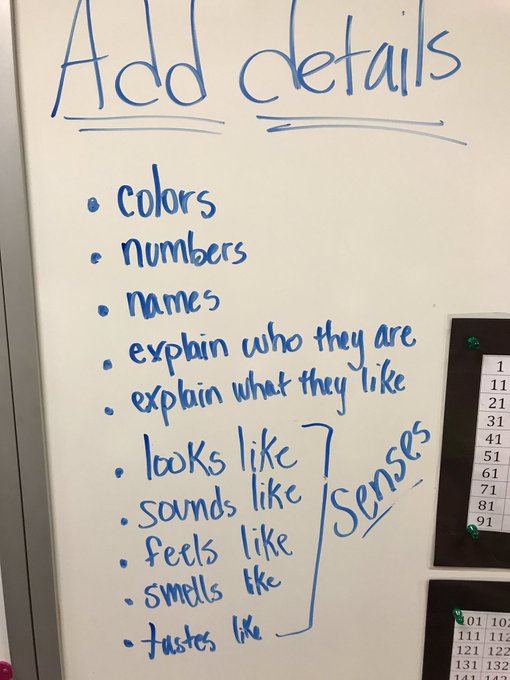
Students have been working on stories where students create characters, the setting, a problem and the final solution.  We have talked about adding details to their stories.
View image on Twitter  View image on Twitter  View image on Twitter

I have also introduced the proper way to format a letter.  Maybe you have received one of these?  They are so very excited to learn how to write one properly.  You may receive more at home that are marked up by me.  Right now, I am focusing on the proper location of the date, greeting, signature, and indenting.  We have only briefly talked about why we indent (when we start a new topic for a paragraph), but will continue to work on that in the future.  Please see the note below about new homework!

Ways to help at home:
- Have fun with your child by writing together.  You could create a story together!
- I will begin journal homework soon.  This is just a way for me to get to know students better and so we can practice writing letters with proper formatting.


Reading:
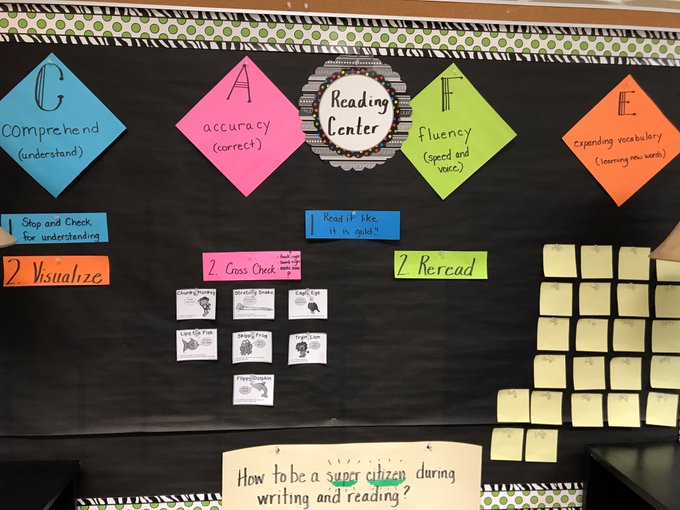
We completed our decoding strategies.  Students have been using Stretchy the Snake, Eagle Eye, Chunky Monkey, Flippy Dolphin, Tryin Lion, Skippy Frog, and Lips the Fish.  Students continue to write new vocabulary words on their sticky notes in which we add to our interactive bulletin board! I don't have a picture of our board this year, but here's a photo from two years ago to give you an idea of a visual reminder we use in class.  There are new sticky notes each week in which we replace the following week depending on the strategy taught.
View image on Twitter

We have recently begun adding comprehension strategies to our Reading Toolbox!  Students are realizing they need to create pictures (or even a movie) in their heads when they read - VISUALIZATION!  Students are also starting to ask questions like:
        - I wonder why...
        - I wonder what...
        - How did...
        - I wonder when...
        - Who...
Students are also beginning to understand the components of a story.  Similar to what we are doing in writing, students are identifying the character, setting, problem, and solution in books they read.


Ways to help at home:
- I write this all the time, but practice does makes perfect!  The more reading your child does, the better they will get!  Research shows between 20-30 minutes per day helps growing readers improve more rapidly. 
- I want students to LOVE to read, just as I do!  To get them to love it, they must love the story.  Let your child choose what to read.  If they are excited and engaged in the story, they will want to read more and more.
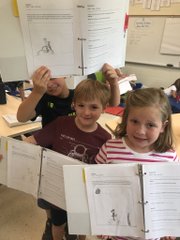
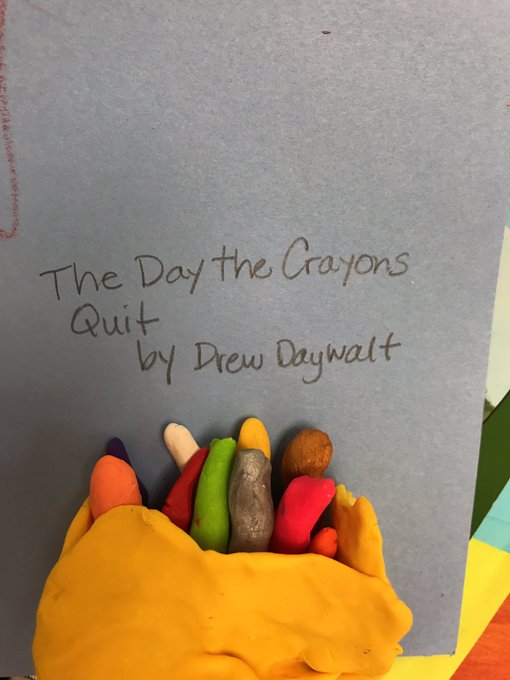
- Check out these reading reflection projects!

View image on Twitter  View image on Twitter  View image on Twitter  View image on Twitter

Math:
We have transitioned into Geometry.  Students are able to identify 2D and 3D shapes.  Here's a chart to describe the different vocabulary terms for each.  Ask your child to explain them!

2D                                                              3D
sides                                                           edges
corners                                                       vertex (vertices)
                                                                   faces
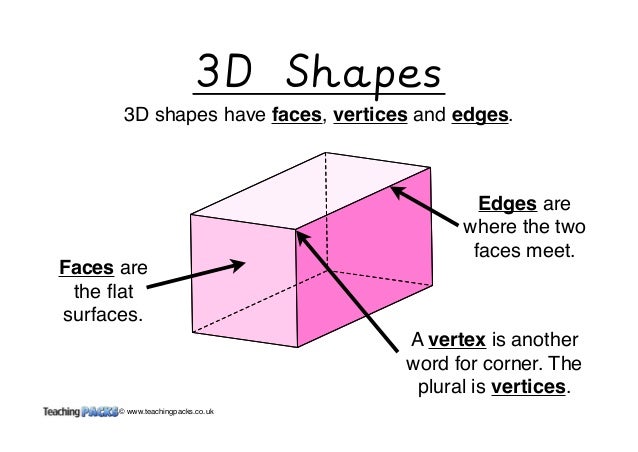
  Image result for image of 3D shape vocabulary
  
Students are also able to distinguish between the three different types of angles and sort shapes based on their angles.
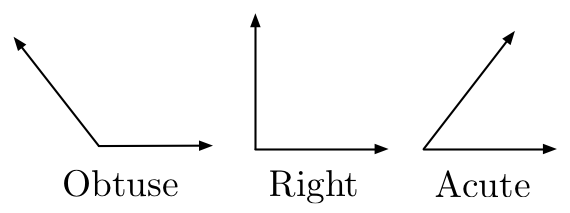
Image result for three types of angles


View image on Twitter  View image on Twitter


Students can also describe the qualities of a rectangle array.  They know that all rectangles have 4 right angles, and can describe them using rows, columns, and total tiles.  For instance, this array can be described as having 4 right angles, 3 columns, 4 rows, and 12 total tiles.

Image result for 4 x 3 array image
 
 
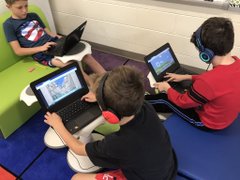
Students still have the ability to work on ST Math at school and at home.  ST Math allows students to explore the concepts we are studying.  I recently introduced them to Reflex Math, which builds students fact fluency.  Both of these are very important to building a solid mathematical foundation.
View image on Twitter  View image on Twitter 

Ways to help at home:
- Continue to create word problems and have them use their own strategy to solve them.
- Ask your child to point out different 3D vocabulary terms on items around your house!  :)

Sunday, September 30, 2018

Our first month...

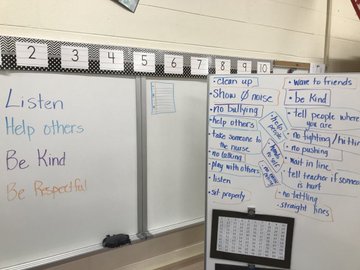
Students are engaged and excited about learning!  They have also been earning and earning rewards for positive behavior!

View image on Twitter  View image on Twitter  View image on Twitter

Here's what we've been up to lately:

Math:
We continue to identify and count coins.  Students are getting so much better in this area and feeling much more confident!  Thank you for helping out at home!  I can see the benefits of this in class with identification of coins.  I gave students this scenario "I have lots of coins in my pocket and need to trade them in so that my pockets aren't nearly as full."  They then played a game in which they exchange coins in order to have the smallest number of coins.


Students are using the following strategies to add larger numbers together:

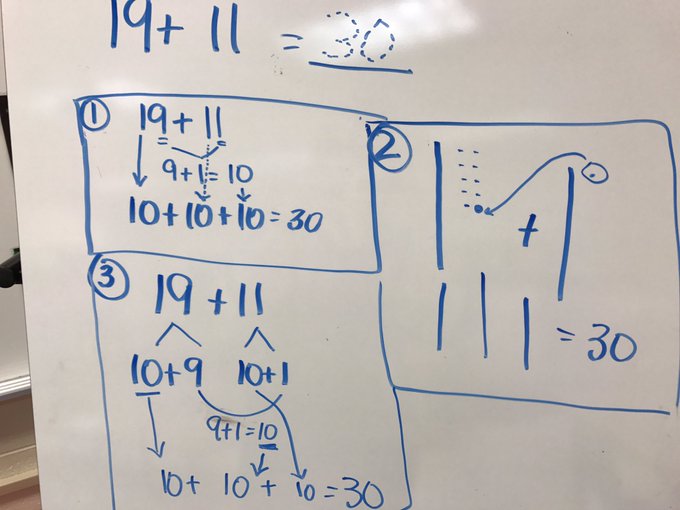
1.  Make 10 - Students make 10.  In 17 + 8 + 3 + 2, students would combine 7 + 3 = 10 and 8 + 2 = 10, so 10 + 10 +10 = 30.

2.  Doubles - Students find doubles when possible.  In 3 + 8 + 8 + 3, students would see that 3 + 3 = 6 and 8 + 8 = 16, so 6 + 16 is 22.

3.  Compensation - Students will determine a ten or a double, but have to use part of another number.  If you have 2 + 7 + 4, you can say 2 + 7 + 1 (from the 4)  = 10, but then 4 - 1 = 3, so 10 + 3 = 13.  OR 5 + 7 + 4, you would make a double of 7 (the 5 + 2 from the 4) + 7 = 14, then 4 - 2= 2, so 14 + 2 = 16.  This strategy is a little more advanced, but I taught it recently to extend to students who were ready for it.  :)

The big focus over the last few weeks has been showing their mathematical thinking. Students had a hard time with this in the beginning, but it is coming more easily to students now.  Students can show their thinking with either pictures, numbers, or words.  If showing thinking in pictures, there must be organization.  I have asked students to arrange circles, dots, squares, etc., in rows of ten.  Here are a few ways:

View image on Twitter


Ways to help at home:
- Continue to count coins.  To extend their thinking, students can play "store."  They can buy items (total less than $1.00) and figure out how much two items would be, then determine the change they get back when they pay with a $1.00 bill!
- Create a story problem with two addends that up to less than 100.  We are just beginning subtraction, so they may need help showing their work.


Word Study:
Students are now in word study as a whole group using common sight words as our sort.  They are learning the routine and the different activities and my expectations.  We have one more week of sight words, then students will be broken into groups based upon where each student is.

Students use wikki sticks (wax strings) to mold the strings to form letters to build their words.  Students love writing their words in FANCY letters or different colored pens! I introduced Word on the computer yesterday and students will have a chance to use it for word study next week.  They LOVE the idea of changing font size and type.  We keep it fun!

View image on Twitter  View image on Twitter  View image on Twitter 

Writing:
The last two weeks has been fun in writing!  This has been a "rose" each day!  Students draw a picture of their character then write about it with details.  Next, students draw the setting around their character then write about it with details.  Coming up this week, students draw their character in the midst of a problem.  They will then write the plot to the story.  Lastly, students draw their character solving the problem.  They will then write about the solution.  This creates a fun, complete story.

Ways to help at home:
Students can write just about anything at home.  They have had experience writing letters, so have them write to someone and tell them about something they are enjoying in school.

Reading:
We continue to add to CAFE, our reading strategy board.  C = comprehend (understanding what you read), A = accuracy (reading correctly - words and prosody/intonation), F = fluency (the speed in which you read), and E (expanding the vocabulary - adding new words)

Students have been building stamina, persevering over challenging parts, but most importantly, students are rereading their text. 

In the upcoming week, students will learn different strategies to read more difficult words.
1.  Lips the Fish - Get their lips ready to make the sounds.
2.  Stretchy the Snake - Sound out each letter as you come to it, then put them together.
3.  Chunky Monkey - Identify parts of words and chunking those parts.  For instance, in the word remake, identifying the word make and putting "re" in front of it.  I used the word OW! as an example so they can identify it in now and down...word study words this week.

View image on Twitter  View image on Twitter  View image on Twitter

Ways to help at home:
- Practice makes perfect!  The more reading your child does, the better they will get!  Research shows between 20-30 minutes per day helps growing readers improve more rapidly. 
- I want students to LOVE to read, just as I do!  To get them to love it, they must love the story.  Let your child choose what to read.  If they are excited and engaged in the story, they will want to read more and more.
- Enjoy some fun project choices.  I have several students who have done a few projects already!  Reminder:  First reading project due by November 1st.


Check out some of the ways students reflected on their reading at home...

View image on Twitter      View image on Twitter


Social Studies:
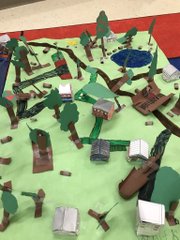
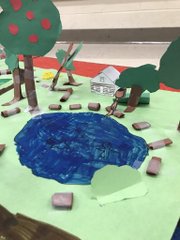
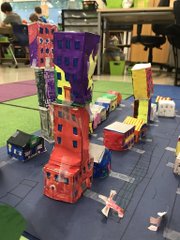
Students have been busy bees the last few weeks!  We began by viewing a Then and Now set of photos by Rufus Holsinger and Stacey Evans (http://uvamagazine.org/articles/charlottesville_then_now).  We then "copied" the idea  by designing a map as a whole class so that both our present and our past maps are the same.  Students began with a Crozet-ish design which included a pond and a tree.  Students then created two 3D maps...a map of the past and of the present.

Students also researched ways the past was different.

View image on Twitter  View image on Twitter  View image on Twitter

Now that they understand the difference, we will begin reading a historical fiction book that describes life on a sheep farm in a small valley in Colorado in the 1920s.  Students will have to visualize life without electricity, running water, and indoor plumbing! 

Here are our maps.  What similarities and differences do you notice?

Past:

View image on Twitter  View image on Twitter  View image on Twitter


Present:
  
View image on Twitter  View image on Twitter  View image on Twitter


Ways to help at home:
- Continue conversations about how life was different when you were young. 

Sunday, September 9, 2018

Welcome!

Welcome 2nd grade parents and students of 2018-2019!

This blog is meant to provide parents with details about the time in our classroom (with pictures!).  I will provide you with an explanation of each content area, as well as ways you can help at home.

Please feel free to ask if you have any questions!

View image on Twitter

Social Studies:
In social studies, we discussed ways to be a super citizen.  We broadened this idea to other content areas the past few weeks (being a super citizen in math, reading and writing workshop)!  Students were able to clearly explain how they could be a super citizen of our classroom community, school community, city community, national community, and global community.

Students spoke about different rules people have to obey.  We came to the conclusion that we have rules in the classroom and those rules should transfer to all areas of our lives.

We learned about Cesar Chavez.  He was a Mexican American who fought for equality in the state of California.  He founded the National Farm Worker's Association, which helped earn farm workers higher wages and better working conditions.

View image on Twitter  View image on Twitter

Ways to help at home:
- When taking a family walk, pick up trash and talk about how super citizens help the community become a better place to live, work and play.
- If you are driving, discuss the different laws you have to obey (stopping at a stop sign, driving the speed limit, etc.).


Reading:
We began this week by learning to choose a "just right" book. We watched the story of Goldilocks and how she needed to have "just right" porridge and a "just right" bed.  Reading is very similar because we can't have books that are too hard or too easy.  We have to find "just right" books as well.  We talked about finding books that are of interest, that they can comprehend, and that they know how to read.  At this time, students are only allowed to choose books from certain bins (easier books).  I will open up other bins and genres after I am able to more formally assess them.  I already know a few students who are either above or below the bins that are available to students, so my hope is to assess those students first so they can get into more "just right" books quickly and don't get bored or frustrated.

This week, students were asked to think of themselves as readers (how do they like to read, with whom do they like to read, and who are model readers they want to be like).  Students answered a survey, drew pictures, and wrote about their reflection as a reader.

We spent quite a bit of time talking and reflecting on reading and were able to make it about 12 minutes of straight reading before several students got bored and started looking around.  At that time, we moved around and started again.  Eventually, students will get to the point where they can read for 30-40 minutes straight and will get cranky when I tell them it's time to clean up!  :)

View image on Twitter 

Ways to help at home:
- The hardest part about reading at home is that you don't know if a book is a "just right" book.  If your child has a book that you aren't sure is a good fit, ask them to read a page or two to you.  If there are more than 5 words that your child does not know, the book is "too big."  If your child can read it, but doesn't really know what it means, it is only a little "too big."
- Don't feel that your child is ever too old to read a book together.  Children learn through your modeling!  Have your child read to you, share the book and each of you read a page, or you read to your child if the book is "too big."  All of these are wonderful ways to spend quality time with your child.


Writing:
Writing this week has included me reading books so that we can make lists of "things to write about" for idea generation.  Students made a list of who they could write about, places they could write about, favorite things they could write about, and experiences they could write about.  I did have a few students who got stuck when writing, so I pulled out my story dice app and they were able to get some ideas!

We have about 10 minutes between specials and lunch, so students spend about 5-10 minutes each day practicing their handwriting while listening to calming music.  During this time, they focus on exactly where their letters should begin and end.  I am amazed at the quality that I get during this time! This will eventually transition to cursive!

View image on Twitter  View image on Twitter  View image on Twitter

Ways to help at home:
Students can write at home.  They could help you with the grocery list, write a letter to family or friends, or just write a creative story.  There are two great apps you can get for your phone (Name Dice and Story Dice by Thinkamingo) that will help when they are stuck.  The Name Dice pops up 2 names at a time and the Story Dice shows 2 or 3 pictures that generate a "situation" that students can write about.  I only allow students to tap it 3 times for ideas or they might get carried away with tapping and not actually thinking about what the picture on the dice could do for their story.


Word Study:
We have yet to start word study.  We will begin in two weeks.  All students will begin with the same sort (sight words) and learn different activities we will use over the school year.  We will then begin words that are determined by where each student is with word study.

Ways to help at home:
- Ask your child to spell easy, commonly used words when you are writing a note or a list.  Remember that words we think are easy (like was or one or what) can be challenging for them because was sounds like it should be spelled wuz.  Choose words that can easily be sounded out.
- I will be teaching students a strategy for harder words.  I ask students to count the sounds for the word.  If we are spelling stamp, there are sounds, so we draw 5 lines, like this _ _ _ _ _.  Then we begin filling in the lines with the sounds we hear.

s _ _ _ _ then
s t _ _ _ then
s t a _ _  then
s t a m _ then
s t a m p

I explain that this might not be exactly how to spell the word, but it would be super close!  For instance, sneak might become sneke or even just snek.  From this point, students who can then use what they know from word study to get even closer.  If they have had the long e sort with ea, then they know they could put an ea on the third line.  If they know that some long e sounds at the end of a word will end with an i, ie or y.  They can then add them and see which one looks familiar.  Ask your child to use this strategy at home.  We will be learning it in a week, but as the year progresses, students will become very good at it.


Math:
The first unit of study is simply seeing what they know, reviewing helpful tools (hundreds chart, number line, etc), introducing games, and simply understanding how the math workshop will flow.  This past few weeks, we have used the hundreds chart to count AND solve simple addition and subtraction problems, began skip counting, identified and counted coins, and solved simple word problems together.  Our biggest focus was making sure students could count 100 objects.  We talked about different strategies, such as counting by twos and placing them in lines of 10 so that anytime I walked up and asked how many they had counted, they would easily be able to tell me.  We used colored cubes so they could count ten of each color, as in the pictures below.  We also reviewed the identification of coins, their value, and counting them (using cubes as a backup counter).  Most students were were successful with both of these tasks, but practice makes perfect.  Below are ways to help your child grow as mathematicians. 

 View image on Twitter  View image on Twitter    View image on Twitter 

View image on Twitter  View image on Twitter 

Ways to help at home:
- Pull out 100+ pennies or beans or... and ask your child to count them.  Students should remember to place them in groups of 10 so they can easily figure out what number they are on should they get confused.
- Ask your child to identify different coins, count a handful of change, and make $1.00 with different coins.


----------------------------------------------------------------------------------------------------------------
Don't forget to come to Back-to-School Night!  On Tuesday, September 11th, come in to hear about a day in the life of your second grader.  In the past, there has been a "State of the School address" by our Principals, but it will be slightly different this year.

Schedule:
6:00 - Come to the classroom and hear Mr. Crutchfield welcome you to Brownsville.  PTO will share a quick video about the work they will do this year.

6:10 - Session 1 begins - I will talk to you about what you can expect this year, how we manage in the classroom each day, and answer any questions you might have.

6:40 - Session 1 ends - please be sure to see your child's artwork in the hallway!

6:50 - Session 2 begins - Again, I will talk to you about what you can expect this year, how we manage in the classroom each day, and answer any questions you might have.  This is the exact same as the first session.

7:30 - Session 2 ends - please be sure to see your child's artwork in the hallway!

Two reminders 
1.  This is a night for parents only.  Parents are asked to leave their children at home, if possible.  
2.  This is an informational session and not a conference.  If you would like to talk with me about your child's specific needs, please send me an email to set up a conference.  Please be mindful of my time during this informational evening.