Pages

Saturday, September 16, 2017

We are busy bees!

It has been fun getting to know students as readers, writers, and mathematicians!  I really do have an amazing group of young minds ready to make a difference!

Here's a look inside our classroom...

Math:
Number identification, counting, coins, hundreds charts, and adding strategies have been the foci in math.  Although students have an idea behind numbers, we take it a step further to ask them to think about different ways to show a number.  Here are some ways we showed the number 7. 
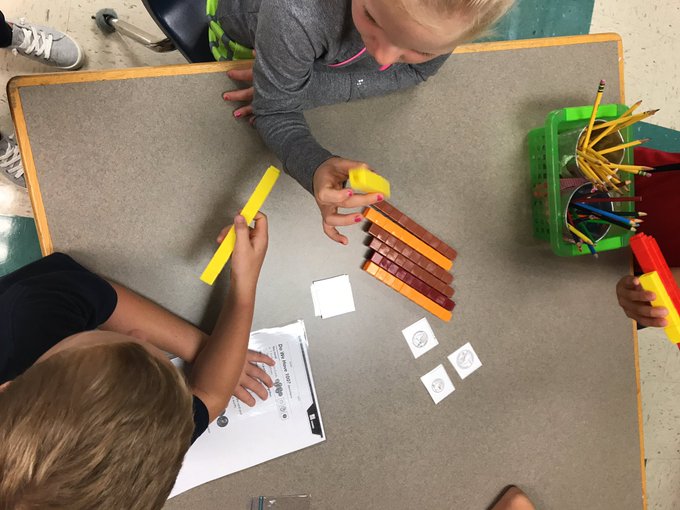
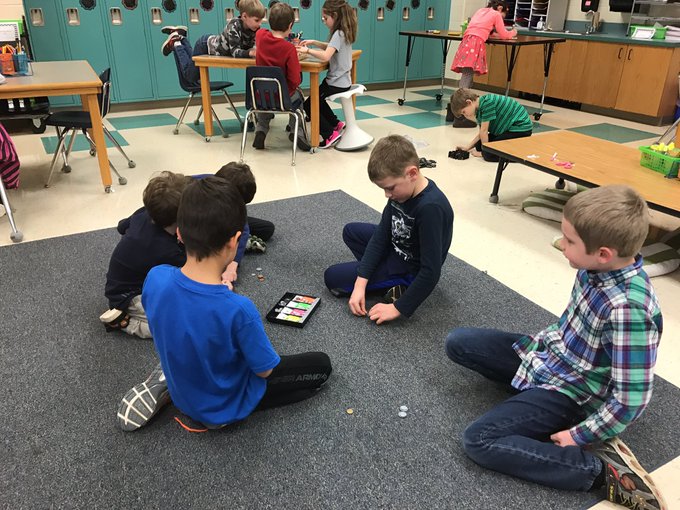
View image on Twitter   View image on Twitter  View image on Twitter  View image on TwitterStudents have realized that rather than counting one block at a time to get to 100, it is easier to place the blocks into groups of 10 and find 10 groups.  We have reviewed the identification and counting of coins in the last few weeks.  Most students are fluent in this area, but it doesn't hurt to practice!  In upcoming weeks, we will play games involving money (counting and making change).  We have been filling in blank spaces in different hundreds charts so students have to either see which number comes before or after OR which number is above or below.  See the example below.
Image result for missing numbers in hundreds chart 

 Lastly, students have been discovering strategies for adding multiple one digit numbers, such as 7 + 8 + 3 + 2.  Here are three strategies we have used...

1.  Make 10 - Students make 10.  In 7 + 8 + 3 + 2, students would combine 7 + 3 = 10 and 8 + 2 = 10, so 10 + 10 = 20.

2.  Doubles - Students find doubles when possible.  In 3 + 8 + 8 + 3, students would see that 3 + 3 = 6 and 8 + 8 = 16, so 6 + 16 is 22. It will be very helpful for students to practice their double facts at home.  A game will be "homework" next week to help with doubles.  :)

3.  Compensating - Students will determine a ten or a double, but have to use (compensate) part of another number.  if you have 2 + 7 + 4, you can say 2 + 7 + 1 (from the 4)  = 10, but then 4 - 1 = 3, so 10 + 3 = 13.  OR 5 + 7 + 4, you would make a double of 7 (the 5 + 2 from the 4) + 7 = 14, then 4 - 2= 2, so 14 + 2 = 16.  This strategy is a little more advanced, but I taught it this week to extend to students who were ready for it.  :)

View image on Twitter  View image on Twitter

View image on Twitter  View image on Twitter

Ways to help at home:
- Pull out a handful of coins.  Ask students to identify the coins, then add up the total amount of change you have.  Children love playing with money, so let them practice their skills!
- Play the Make 10 game that was sent home this past week.  Students enjoy playing and it will help build the foundation of adding and subtracting quickly.
- Play Tens Go Fish.  We have not yet played this game in the classroom, but it is an adding way of Go Fish.  Instead of asking for pairs (I have an 8, so I ask for an 8 to match it), you ask for the addend that will help you get to 10 (I have an 8, so I ask for a 2 to =10).


Word Study:
We began word study this past week.  We started with a very simple sight word list.  These words are commonly misspelled by students as they work their way through 2nd grade.  I am using this sort (and next week's sight word list) as a way to introduce many of the activities that follow them sorting their words (with me) and writing their list twice (independently) on a daily basis.  I want students to know my expectations for each activity before "turning them loose" with their true sorts.  Each day, students work with me to sort their words, then they write their words twice, then do an activity.  Their full word study session lasts about 30 minutes.  We will begin true sort groups the week of the 25th.

Ways to help at home:
I'm leaving these ideas from the last post because I feel they can help most!
- Ask your child to spell easy, commonly used words when you are writing a note or a list.  Remember that words we think are easy (like was or one or what) can be challenging for them because was sounds like it should be spelled wuz.  Choose words that can easily be sounded out.
- I am teaching students a strategy for harder words.  We practiced this with our word study words two days so students could understand how it works.  We will continue with it throughout the year.  The other day we spelled sneaky together.  I asked students to count the sounds (5), so we drew 5 lines, like this _ _ _ _ _.  Then we began filling in the lines with the sounds we heard.

s _ _ _ _ then
s n _ _ _ then
s n e _ _  then
s n e k _ then
s n e k e

I explained that this might not be exactly how to spell the word, but it would be super close!  From this point, students who can then use what they know from word study to get even closer.  If they have had the long e sort with ea, then they know they could put an ea on the third line.  If they know that some long e sounds at the end of a word will end with an i, ie or y.  They can then add them and see which one looks familiar.  Ask your child to use this strategy at home.  We are just learning it, but as the year progresses, students will become very good at it.

Writing:
We try to begin our writing time with a short 5 minute "ABC write."  During this time, students focus on writing their letters correctly (no ds for bs or E for 3) and taking time to focus on where their letters should "touch" (bottom line, middle line, top line).  We play classical music during this time and just be mindful!
View image on Twitter  View image on Twitter  View image on Twitter

We will begin our creative writing in the upcoming week.  I plan to have students draw a picture of their character, then write about it with details.  Then, students will draw the setting around their character, then write about it with details.  Next, I will have students draw their character in the midst of a problem.  They will then write the plot to the story.  Lastly, I will ask students to draw their character solving the problem.  They will then write about the solution.

Ways to help at home:
Students can write at home, although some don't want to.  :)  Use the idea above to draw a character and setting and just write about it.  They love drawing and this is a wonderful way to connect the two.

I suggested last post that they could help you with the grocery list, write a letter to family or friends, or just write a creative story.  There are two great apps you can get for your phone (Name Dice and Story Dice by Thinkamingo) that will help when they are stuck.  The Name Dice pops up 2 names at a time and the Story Dice shows 2 or 3 pictures that generate a "situation" that students can write about.  I only allow students to tap it 3 times for ideas or they might get carried away with tapping and not actually thinking about what the picture on the dice could do for their story.

Reading:
This past week, I introduced students to CAFE, our reading strategy board.  C = comprehend (understanding what you read), A = accuracy (reading correctly - words and prosody/intonation), F = fluency (the speed in which you read), and E (expanding the vocabulary - adding new words)

Throughout the year, we will add different strategies to each "section" of our CAFE board.  This week, we introduced Stop and Check for understanding under the C.  Students practiced stopping to make sure they were understanding the story they were reading.  If yes, then it is a "just right" book.  If not, maybe they need to wait a month or two to read it and get a better "just right" book.  We also added "Read it like gold" under the Accuracy AND Fluency.  We read like a curmudgeon (bad-tempered reader), which we found was very boring.  We then read it like gold and found we added voices to characters and made the story much more interesting!  Lastly, we added Cross Check to Accuracy.  When students came upon a word they didn't know, they did the best they could to figure it out and when they got it, they cross checked (does it look right?  does it sound right?  does it make sense?).  I am hopeful these strategies (in addition to those being introduced in the future) will help students become more confident readers.

View image on Twitter

View image on Twitter  View image on Twitter  View image on Twitter 

Ways to help at home:
- Practice makes perfect!  The more reading your child does, the better they will get!  Research shows between 20-30 minutes per day helps growing readers improve more rapidly.  I tell students that I was not the best reader in 2nd grade, but I worked very hard and made great progress and now I can read most anything.
- I want students to LOVE to read, just as I do!  To get them to love it, they must love the story.  Let your child choose what to read.  If they are excited and engaged in the story, they will want to read more and more. 
- I'm leaving this one...Don't feel that your child is ever too old to read a book together.  Children learn through your modeling!  Have your child read to you, share the book and each of you read a page, or you read to your child if the book is "too big."  All of these are wonderful ways to spend quality time with your child.

Social Studies:
Our theme is super citizens.  Over the past few weeks, we have been creating super citizens in the classroom.  I introduced students to a super citizen who made a difference in our nation many years ago.  Cesar Chavez was a Mexican American who lived a life of poverty.  His family were farm workers throughout California after their Arizona farm had to be forfeited because of the depression and a draught.  Cesar noticed the different pay scale for white Americans, Mexican Americans, and Mexicans.  He formed the National Farm Workers Association to help fight for equal pay among all races.

We are now learning about the past and present.  Students worked in groups to determine ways of communication and types of transportation that have been used throughout history.  They loved watching short clips of my favorite cartoons growing up.  We watched Flinstone "inventions" and Jetsons "inventions" that ultimately came true.  We compared these ideas of past and future to the present.  We will "make it more real" in the weeks to come as students explore Charlottesville in the Past through photos.  We will then make a past and present 3D map.

View image on Twitter  View image on Twitter  View image on Twitter

Ways to help at home:
- Thank you for taking part in the Interview homework.  I hope it helped students a) get to know their interviewee better (and in a different way), and b) understood how life was different not too long ago.  Continue to talk about the changes in technology, transportation, and communication with your child.  Find books about the past (Little House is a wonderful series to show life in the past...Big Woods or Long Winter are great!), listen to music from the past, or read through old letters you might have.  Make it fun and interesting!

FUN:
Look at these sweet faces!

View image on Twitter  View image on Twitter 

View image on Twitter  Notice that D (Darci) lost big time!  :)

 View image on Twitter View image on Twitter 

View image on Twitter  View image on Twitter

Sunday, September 3, 2017

It's official...we are already working hard!

It's true!  This past week was our first full week, so why not start diving in to the curriculum!

Upcoming blog posts will be laid out by content.  You can read about each subject we are covering.  I will talk about what we are learning and include some helpful hints on how to help your child at home.

Math:
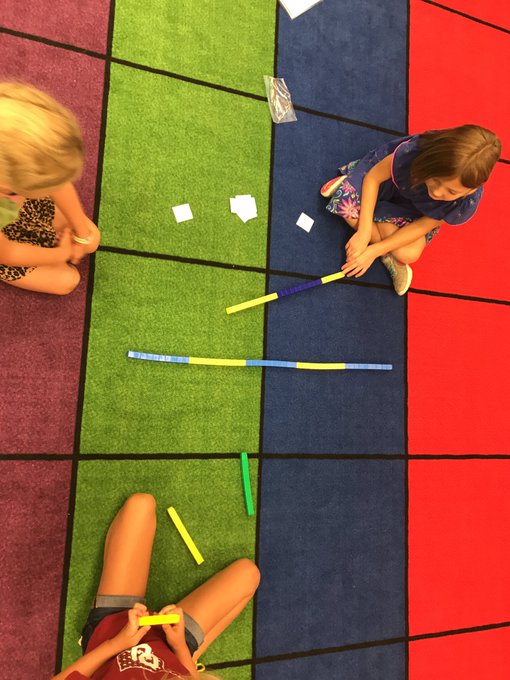
The first unit of study is simply seeing what they know, reviewing helpful tools (hundreds chart, number line, etc), introducing games, and simply understanding how the math period will flow.  This past week, we used the hundreds chart to count AND solve simple addition and subtraction problems, began skip counting, identified and counted coins, and solved simple word problems together.  Our biggest focus was making sure students could count 100 objects.  We talked about different strategies, such as counting by twos and placing them in groups of 10 so that anytime I walked up and asked how many they had counted, they would easily be able to tell me.  We used colored cubes so they could count ten of each color, as in the pictures below.  We also reviewed the identification of coins, their value, and counting them (using cubes as a backup counter).  Most students were able to do both of these tasks, but it doesn't hurt to practice.  Below are ways to help your child grow as mathematicians. 

 View image on Twitter    View image on Twitter

Ways to help at home:
- Pull out 100+ pennies or beans or... and ask your child to count them.  Students should remember to place them in groups of 5 or 10 so they can easily figure out what number they are on should they get confused.
- Ask your child to identify different coins, count a handful of change, and make $1.00 with different coins.

Word Study:
We have yet to start word study.  We will begin in two weeks.  All students will begin with the same sort (sight words) and learn different activities we will use over the school year.

Ways to help at home:
- Ask your child to spell easy, commonly used words when you are writing a note or a list.  Remember that words we think are easy (like was or one or what) can be challenging for them because was sounds like it should be spelled wuz.  Choose words that can easily be sounded out.
- I am teaching students a strategy for harder words.  The other day we spelled sneaky together.  I asked students to count the sounds (5), so we drew 5 lines, like this _ _ _ _ _.  Then we began filling in the lines with the sounds we heard.

s _ _ _ _ then
s n _ _ _ then
s n e _ _  then
s n e k _ then
s n e k e

I explained that this might not be exactly how to spell the word, but it would be super close!  From this point, students who can then use what they know from word study to get even closer.  If they have had the long e sort with ea, then they know they could put an ea on the third line.  If they know that some long e sounds at the end of a word will end with an i, ie or y.  They can then add them and see which one looks familiar.  Ask your child to use this strategy at home.  We are just learning it, but as the year progresses, students will become very good at it.

Writing:
Writing this week has included reading books and making lists of "things to write about" for idea generation.  Students made a list of who they could write about, places they could write about, favorite things they could write about, and in the upcoming week, they will add experiences they could write about.  We read books that used these components and then I used my list to create a "mostly true" story about a time my daughter and I were snorkeling in Kauai and saw a Hawaiian Monk Seal and a completely fictional story about a green monkey (my favorite animal) who photo bombed a wedding at a temple outside Tokyo (a place I visited).  Students were able to witness how their own experiences can help them write a wonderful story.  I did have a few students who got stuck when writing, so I pulled out my story dice app and they were able to get some ideas!

View image on Twitter

Ways to help at home:
Students can write at home.  They could help you with the grocery list, write a letter to family or friends, or just write a creative story.  There are two great apps you can get for your phone (Name Dice and Story Dice by Thinkamingo) that will help when they are stuck.  The Name Dice pops up 2 names at a time and the Story Dice shows 2 or 3 pictures that generate a "situation" that students can write about.  I only allow students to tap it 3 times for ideas or they might get carried away with tapping and not actually thinking about what the picture on the dice could do for their story.

Reading:
We began this week by learning to choose a "just right" book.  I told the students the story of Goldilocks and how she needed to have "just right" porridge and a "just right" bed.  Reading is very similar because we can't have books that are too hard or too easy.  We have to find "just right" books as well.  We talked about finding books that are of interest, that they can comprehend, and that they know how to read.  At this time, students are only allowed to choose books from certain bins (easier books).  I will open up other bins and genres after I am able to more formally assess them.  I already know a few students who are either above or below the bins that are available to students, so my hope is to assess those students first so they can get into more "just right" books quickly and don't get bored or frustrated.

This week, students were asked to think of themselves as readers (how do they like to read, with whom do they like to read, and who are model readers they want to be like).  Students answered a survey, drew pictures, and wrote about their reflection as a reader.

We spent quite a bit of time talking and reflecting on reading and were able to make it about 9 minutes of straight reading before several students got bored and started looking around.  At that time, we moved around and started again.  Eventually, students will get to the point where they can read for 30-40 minutes straight and will get cranky when I tell them it's time to clean up!  :)

Ways to help at home:
- The hardest part about reading at home is that you don't know if a book is a "just right" book.  If your child has a book that you aren't sure is a good fit, ask them to read a page or two to you.  If there are more than 5 words that your child does not know, the book is "too big."  If your child can read it, but doesn't really know what it means, it is only a little "too big."
- Don't feel that your child is ever too old to read a book together.  Children learn through your modeling!  Have your child read to you, share the book and each of you read a page, or you read to your child if the book is "too big."  All of these are wonderful ways to spend quality time with your child.

Social Studies:
In social studies, we discussed ways to be a super citizen.  This even broadened this topic through other content areas this week (being a super citizen in reading and writing workshop)!  Students were able to clearly explain how they could be a super citizen of our classroom community, school community, city community, national community, and global community.

Students were able to clearly distinguish the difference between rules and laws.  They know rules are made by groups of people and each person is held accountable on their own, but laws are made and upheld by the government.  Students provided examples of rules (being respectful, following directions, etc) and laws (obeying the speed limit and not stealing).  FYI - we went the simple route and didn't get into inappropriate laws!  :)

Ways to help at home:
- When taking a family walk, pick up trash and talk about how super citizens help the community become a better place to live, work and play.
- If you are driving, discuss the different laws you have to obey (stopping at a stop sign, driving the speed limit, etc.)


Wednesday, August 23, 2017

Welcome to a new school year!

I simply cannot believe it is already August 23rd and the first day of school is finished!  WOW!  It seems like just yesterday, I was sleeping in (my two dogs don't let me sleep too late!) and had a moment to myself before carting my daughter off to that days swimming events.  But boy was it a great day.  The children are so sweet and huggy!  I love hugs and got about 30 throughout the day.  It totally made my day!

Much of today was spent with me talking about expectations in the classroom, in the hallway, at lunch, and at recess.  We did get a few fun games in today.  Tomorrow and Friday we will bring on the fun building our community as we get to know one another better.  Next week, watchout because the academic aspect of school begins and those little brains will be working overtime!  :)

I look forward to a wonderful first week!

Monday, May 8, 2017

Can you believe it is May?

Where has the time gone?  I can't believe it is already May and we have about a month of school left.  Whew!

What have we been up to lately?  Well, let's find out...

Math:
Students have been working very hard at mastering addition and subtraction problems using many different strategies.  Students use blocks (representational form), drawings of blocks, or expanded form (63 + 28 turns into 60 + 3 + 20 + 8).  Regardless of the strategy, students know they should begin with the ones place and then move to the tens place.  This will help them when they begin using the algorithm.  "Start with the ones"  has been a chant all year long and I feel that it is sinking in!  We have seen first hand what happens when you start with the tens only to find out you have another ten with your ones (3 + 8 = 11 in the example above).

Students have been working very hard on "count-bys."  We chant 2, 4, 6, 8, 10, 12, 14, 16... or 6, 16, 26, 36, 46, 56, 66... or 129, 119, 109, 99, 89, 79... or even 125, 120, 115, 110, 105, 100, 95, 90, 85, 80.  We practiced count-bys with balloons...

 View image on Twitter

We have recently began work with fractions.  We are identifying fractions and making fractions.  We use different country flags to show the different fractions.  Students get very excited when they can design their own flag.  :)  I am trying to get them to see equivalent fractions (2/4 = 1/2 or 4/4 = 1 whole!!), but this is challenging for them.  Any examples you find at home would be helpful.

View image on Twitter

Reading:
Non Fiction was a significant part of the last few months.  Students worked hard to learn many different vocabulary terms, their definitions, and then provide examples of each.  Here are some that students need to know:


Bold Print

Graph

used to draw attention to words that are important within the text. 


used to show data that is important to the text.


Bullets

Glossary

used to list items about one topic within the text.


defines all of the bold print vocabulary words

Caption

Heading

explanations found at the bottom of pictures, drawings, or graphs. 


used to summarize that section of the story in one word

Diagram

Photograph

drawings that explain something within the text.


used to visually provide information to the story

Fact Box

Table of Contents

used to give general facts


located at the beginning of the text to tell the reader on which page to find information about a specific topic.


 View image on Twitter  View image on Twitter

One student even wore a shirt with an example of a diagram!

 View image on Twitter

Lately, we have been reading fairy tales/fantasy books to support our comprehension focus, which is summarizing.  We do this in two ways.  First, students can summarize by naming the character and telling where he/she is (setting), then providing a one sentence problem and one sentence solution.  The second way we can summarize is to say "Somebody ___ wanted __, so ___, then___."  Students
- name the character
- tell what the character wanted
- tell the problem
- give the solution

So often, students want to provide MANY details, but that really isn't a summary, is it?  :)  It sounds easy, but this is one of the hardest comprehension strategies for students.

Word Study:
Each day, students continue to sort new word study sorts, write their sorts, then do a new activity.  I thought the favorite word study activity would be writing in pen, but they recently said that creating a word search puzzle with their words was the favorite.  ...until next week, I'm sure!

All students are doing well and spelling their words correctly on the quiz as well as in their daily writing.

 View image on Twitter

Writing:
Students continue to write stories with details on the character, setting, problem, and solution.  Students are very excited to work in small groups to create a skit to perform for parents.  I will let you know of that date as soon as it has been finalized.

Social Studies:
We finally finished up our continents and oceans unit.  I am actually quite sad because I feel the students loved it and really learned more than I expected they would.  The culminating activity was our Around the World Day.  Students traveled far and wide (ok, just down the hallway) to different continents (ok, 2nd grade classrooms) to work with specialists (ok, teachers) to learn more about the culture in each continent.  They made "jewelry," paintings, animals, cultural items, and had food from the different continents.  For instance, in Antarctica, we made a penguin and ate chocolate.  Why chocolate? you ask, well, I told this story...

A researcher (new to Antarctica) couldn't figure out why his fellow researched only packed chocolate bars on day-long expeditions into the tundra.  The night before, he packed his lunch with a super scrumptious sandwich with bread, mayo, 3 types of meat, cheese, lettuce, and tomato.  He stuffed it into his backpack the next morning and went about his outdoor expedition.  Like most days in Antarctica, the weather was below zero and by noon, he had been hiking awhile and was eager to eat his sandwich.  Well, he pulled it out and realized it was a sandwich cube instead.  While he crunched on sandwich ice, the other researchers broke off bits of chocolate and ate away and he now understood why the others packed only chocolate bars.  From that point on, he followed the example set by others and packed chocolate bars!

Students are now researching different famous Americans.  We are learning about George Washington, Thomas Jefferson, Abraham Lincoln, Rosa Parks, Martin Luther King, Jr., Thurgood Marshall, Jackie Robinson, George Washington Carver, Helen Keller, and Susan B. Anthony.

 View image on Twitter  View image on Twitter

We are in the process of creating a massive timeline in which important dates for these famous Americans will be written.

Science:
We will begin a unit about animals next week.  Students will learn about different adaptations of animals around the world.  Students will then research an animal and describe its adaptations.  Students will then create an animal that has special adaptations for different habitats.  It should be fun!

Monday, February 13, 2017

It is mid-February - Can you believe this weather?

Speaking of weather, we will begin our weather unit this week in Science! We are also having loads of fun!


View image on TwitterView image on Twitter
View image on TwitterView image on Twitter            

Writing:
Students worked in small groups to write stories for the Henley Middle School theater students, who will perform a few of the stories as a play.  We can't wait to see the stories come alive in mid-March!

We have stories about boats lost at sea, Officer Puppy Paws solving problems, and demi-gods!  They were all wonderful stories...I wonder which stories will be chosen!  :)

Continue to work with your child at home by asking them to write complete sentences.  Just when I think students have this, they revert back to placing periods in random places.  

View image on Twitter    

Reading:
Over the last few weeks, students have been predicting what will happen next in their book.  Students think about an event that is happening in their book, then use their schema to predict what will happen next. 

In our partner books, students still practice all that we've learned so far this year.  They talk with their partners about their schema, what they've visualized, whether they can connect their reading to something in their life, and certainly ask each other many questions as they read.  These review strategies can be used at home.  I have recently started journaling with my daughter about a book we are both reading.  We ask each other questions based upon comprehension strategies they are learning about in 5th grade.  Feel free to ask me further questions so you can use this idea at home!

Schema - We have used our schema to think about what we already know before we read and what we can add to that knowledge after we read.

Visualization - Students have drawn pictures and used words to explain what they visualize as they read.

Connections - It is becoming easier for students to make connections to what they read.  They are constantly sharing with me what a part in their book reminds them of.

Questioning and Wondering - Students ask questions before, during and after they read.  They ask both "thin" and "thick" questions.  Thin questions are those that can easily be answered in the book (or the part they've already read) by turning to a specific page and pointing to the answer.  Thick questions spark a conversation and there isn't an exact answer to the question, but more of an opinion of what the readers think. Determining the difference between a thick and thin question is still challenging for some students, but they know how to answer the question, just not asking it.

Here are some thick question stems...
- I wonder what would happen if...
- I wonder why...
- What do you think about...
- Where do you think...
-  How did...

View image on Twitter     View image on Twitter     View image on Twitter

View image on Twitter     View image on Twitter


We believe that the meaningful interactions between students, texts, and teachers lead to lifelong learning, empowerment, enjoyment and success.


Word Study:
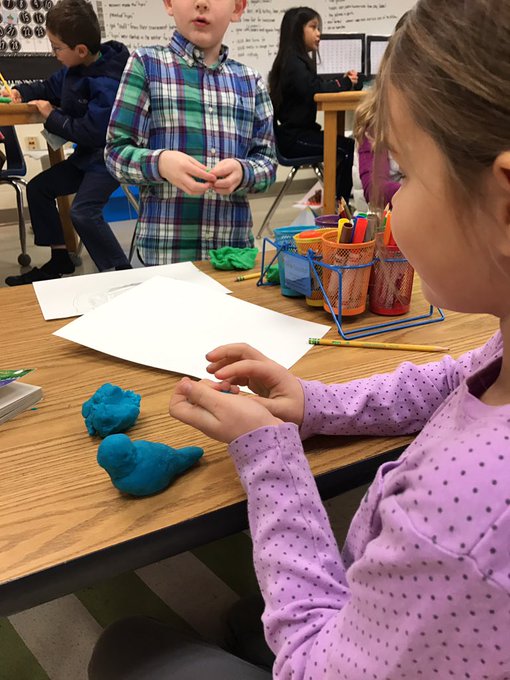
New word study sorts were given out this week.  On a daily basis, students sort their words, write their sorts once, and practice by way of different activities.  Some examples of word study activities is using wikki sticks, play dough, tiles or colored pens.  Use that old Scrabble game and have your children spell out their word study words using the tiles.  Likely, they won't complain about doing their homework!

View image on Twitter     View image on Twitter     View image on Twitter

Math:
We have moved from story problems and count-bys to taking data and placing into a graph.  We were recently introduced to a Venn Diagram, which takes two attributes and sorts them into:
- applies to attribute #1
- applies to attribute #2
- applies to both attributes
- applies to neither attribute

View image on Twitter     View image on Twitter    View image on Twitter    

We have briefly talked about bar graphs and will introduce picture and picto graphs soon.  Picture graphs are graphs that use several different pictures.  A pictograph uses only one picture and has a key that has the picture = a certain number.  Here are a few pictures...

Help your child by looking at different graphs and "reading" them.

Social Studies:
We have learned concluded our unit on American Indians.  Students used all of their gained knowledge on the Lakota, Powhatan, and Pueblo tribes to complete a chart.  Students then planned (OUTSIDE ON A NICE DAY!) and created trioramas for each tribe AND one that displayed similarities between all three tribes.  What wonderful work!

View image on Twitter      View image on Twitter      View image on Twitter    View image on Twitter

Science:
We will begin learning about weather this week.  Students will need to know that weather includes temperature, precipitation, and wind.  Students will learn about storms, different types of precipitation, and the water cycle and how weather influences it.