Pages

Sunday, March 11, 2018

Hello and Goodbye

We welcomed a new friend, Asher, and said goodbye to an old friend, Niyla, but through it all, we are still learning!

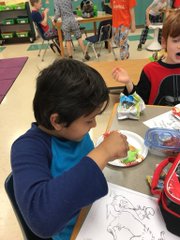
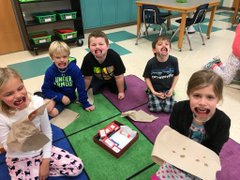
On Dr. Seuss day, we read lots and had fun!  We even ate green eggs and ham!  :)

View image on Twitter  View image on Twitter  View image on Twitter  View image on Twitter 

Social Studies/Science:
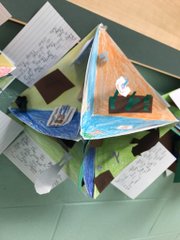
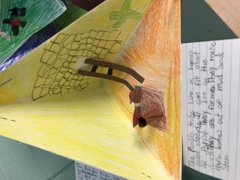
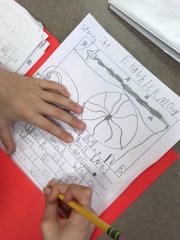
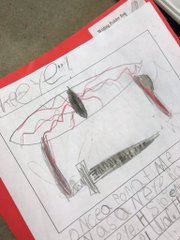
We ended our American Indians unit with a huge project that showed everything we knew about the Pueblo, Lakota, and Powhatan tribes.  Students created four triaromas; one for each tribe and one to show the commonalities about the three tribes.  Students then wrote a few sentences to capture the essence of their project.

View image on Twitter  View image on Twitter  View image on Twitter  View image on Twitter

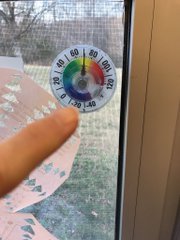
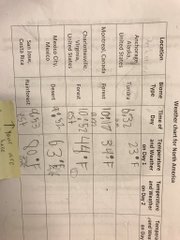
We discussed weather next.  Students learned how to read a thermometer and how to view a website to get the temperature, wind speed and direction, and the forecast.  We sang a song about the weather cycle to the tune of Oh My Darlin'.  Students now know that precipitation is part of the water cycle and can be in the form of rain, snow, hail, and sleet. 

View image on Twitter  View image on Twitter  View image on Twitter

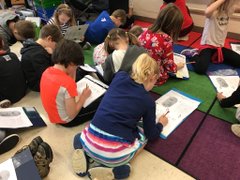
We are now using our knowledge about weather and the American Indian tribe locations to learn about North America (and the other continents).  We are joining forces with Ms. Carew's class to study continents and oceans over the next few weeks.  Students are asking wonderful questions and getting a sense of the location, weather, biomes, and a few cities within the continent.
View image on Twitter  View image on Twitter  View image on Twitter 


Ways to help at home:
- Find books or videos on continents or oceans.
- Have your child tell you all they know about the continent.
- Create a map of a continent we have studied.


Word Study:
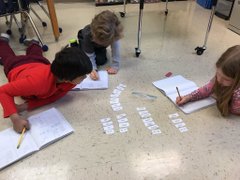
We enjoy activities in word study each day.  We are now even typing our words on the computer every other week!  Please let me know if you have any questions about the sorts that are going home.
View image on Twitter  View image on Twitter  View image on Twitter  View image on Twitter

Writing:
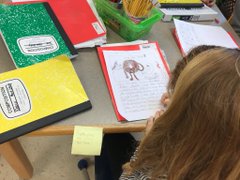
Most students enjoy writing time!  There are few who have a hard time finding ideas, but then they use my story dice app and hurry back to their desks to write.

We have focused the year on writing stories with a character introduction, a detailed setting paragraph, a problem paragraph or two, and an ending with more than just one sentence.  Students are still trying to understand writing a complete sentence with a capital letter and punctuation, but they are getting very good at writing paragraphs on one topic.  This story structure helps them with that idea.
View image on Twitter  View image on Twitter  View image on Twitter

Ways to help at home:
- Ask students to write complete sentences about their day.  Be sure they capitalize and add punctuation.
- Keep a journal of fun events.
- Write a letter to a relative.  Be sure they use a proper letter-writing format.


Reading:
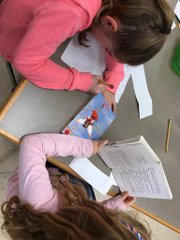
Students continue to work on comprehension.  A recent project included creating a character hand, a setting bookmark, and a problem/solution foldable.  For the character hand, students trace their hand, write the character's name in the palm and five character traits, one in each finger.  Lastly, they draw a detailed picture of their character.  The setting bookmark is a detailed picture of one setting within their book.  The problem and solution are explained and illustrated in the foldable.  This is a great way for students to think about summarizing their book.

We have recently started talking about making predictions.  I prefer that they THINK about it a bit first.  Students read for about 10 minutes, then they choose one event that is taking place in their book.  Next, they use all the schema that they know about that event, then they make a prediction based on the event and their schema.  For example, we are reading a book called A Castle in the Attic by Elizabeth Winthrop.  In the beginning of the book, a boy is given a castle with a silver lead knight, which is about 2 inches tall.  We brainstormed our schema - what we know about castles and knights and realized that castles are enormous and knights usually dress in metal armor.  We also connected wizards and dragons to stories about castles and knights.  Our prediction is that the boy will somehow join the knight in protecting the castle against dragons and magic.
          
Image result for a castle in the attic book covers  View image on Twitter  View image on Twitter  View image on Twitter

Ways to help at home:
- As always, continue to have your child read between 20-30 minutes per day.
- Make predictions using events in your book and your schema.
- Create fun projects!  If reading about a castle, build one with cardboard boxes!


Math:
We continue to move along in math.  Students are being exposed to numbers up to 999!  We are currently working on addition up to 150 and they are doing very well.  Although some students still need to draw a ten rod and ones, most students are now using numbers to solve problems.  I have recommended they start with ones, move to tens, then to hundreds.  This will get them to think this ways so when they are introduced to the algorithm, they begin with the ones, then the tens, then the hundreds.  Here is an example:

128 + 34 = ___

ones:  8 + 4 = 12  (we have created a ten, so we add it first in our next step and now have 12-10 = 2)

tens:  10 + 20 + 30 = 60

hundreds:  100

Now add them all together   100 + 60 + 2 = 162

Most of the work we do is through word problems or games.  The word problems builds their ability to problem solve.  The games focus on strategies to solve the word problems.

   
We have also been working on graphing data.  Students remembered a bar graph from first grade and were introduced to a line plot!  We used everything from cubes to colored Goldfish!

View image on Twitter  View image on Twitter  View image on Twitter  


Ways to help at home:
- Ask your child how to play Capture 5!
- Continue to work with your child on telling time (we have been working on time to 5 minutes) and counting money.
- Continue to allow your child to work on ST Math at home, which will greatly build their number sense!
- Not many students are using Reflex Math, so please don't forget to build fact fluency at home.

Tuesday, January 23, 2018

It feels like it's been awhile! :)

Although it has been over a month since we've had a full week of school, I feel that students are right on track and have kept most of their reading stamina and knowledge, as well as their math understanding.  Thank you to parents for continuing all of our hard work at home over the break and on snow days!

Fun times:

View image on Twitter View image on Twitter   View image on Twitter 

View image on Twitter


View image on Twitter

Social Studies:
Students are taking all that they know about the United States and using it to understand the American Indians.  Students used computers to research the Powhatan tribe.  The Powhatan's were located in Virginia (Pocahontas was Chief Powhatan's daughter), lived in longhouses, walked or rode in canoes for transportation, hunted deer and grew gardens.  Students are now learning about the Lakota tribe through videos and pictures.  They have learned that the Lakota tribe lived in the Plains, near Wyoming and the Dakotas.  Buffalo was the main food for the Lakota people.  The Lakota tribe lived in teepees because they were easy to take down and move to a new location because they followed the buffalo!  We will soon learn about the Pueblo tribe with Mrs. Hartman.  By the end of the unit, students will know the difference between the three tribes in the areas of location, food, shelter, and 

View image on Twitter  View image on Twitter
  View image on Twitter  View image on Twitter

Ways to help at home:
- Find books or videos on the American Indians.  Make a teepee (when Bree was in 2nd grade, she begged us to make a teepee!) or pick berries in the wild.  This summer, grow beans (a popular crop of the Powhatan tribe) or maize (aka corn!). 


Word Study:
We began word study last week, but have had a few "snow days," so we haven't had a chance to get into the groove yet.  :)  Students continue to sort their words with me, write their sort once, and then do an activity.  They have enjoyed writing their sort in alphabetically!


Writing:
Students are writing stories, letters, notes, and even poems!  Most students enjoy writing time.  We will begin a fun new writing project next week.  Students will write stories as small groups next week.  Once completed, we will give our stories to Henley Middle School's drama department.  They will make them into plays, which we will watch in March! 

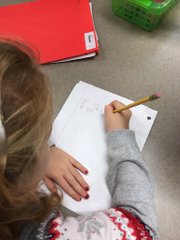
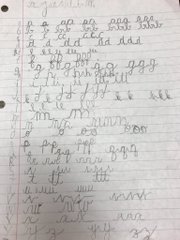
Students were also introduced to cursive.  They love practicing it!

View image on Twitter  View image on Twitter

Ways to help at home:
- Give your child a simple picture and ask them to describe it using lots of details.
- Ask your child to write a letter to a grandparent or relative who lives far away.


Reading:
We continue to spend time on visualization. When you read deeply, you create a series of pictures in your head.  This helps you to comprehend what you are reading.

Last week, we began reading with a partner.  Both students are reading on the same level.  At the end of each session, students share their favorite part, a part they have visualized easily, new details about the character, and even drawn pictures to share with one another.

View image on Twitter  View image on Twitter  View image on Twitter  View image on Twitter  View image on Twitter View image on Twitter 

Ways to help at home:
- As always, continue to have your child read between 20-30 minutes per day. 
- Make reading fun and interesting.  Search for "Readers Theater" scripts online and have your children and friends create costumes and star in one of the plays!


Math:
Students continue to grow as mathematicians!  Students are solving problems using pictures, numbers, and even words.  I have introduced them to many different strategies and students have been able to explore them and then determine which strategy is right for them at that time.

To make sure students are gaining an understanding of the concept of adding numbers, we play games.  Students are able to add and subtract by ones, fives, and tens in these games.

We are currently working on problems with a sum of up to 100, but in the next few weeks, we will get to the point where the two addends are in the hundreds with a sum up to 500.

Lastly, we have computers on Friday afternoons in which we spend time on ST Math.  Most students are making progress, but the concept of adding is building throughout each level they play on ST Math.  Continue to allow your child to work on ST Math at home, which will greatly build their number sense!

View image on Twitter   View image on Twitter 

View image on Twitter View image on Twitter     View image on Twitter  View image on Twitter    View image on Twitter  View image on Twitter
  
Ways to help at home:
- Ask your child to show you how to solve a problem a few different ways!